Fish and History...
Jan. 5th, 2006 03:56 pm![[personal profile]](https://www.dreamwidth.org/img/silk/identity/user.png) senoritafish
senoritafishAn elderly gentleman who is writing a book on the history of commercial fishing in the Los Angeles area often calls me with questions about sardines. I guess he's the scion of a prominent local family; a major street in San Pedro is named after his father. Today he gave me a call for some clarification on the name of the fish; he had read somewhere that someone said "There is no such thing as a sardine."
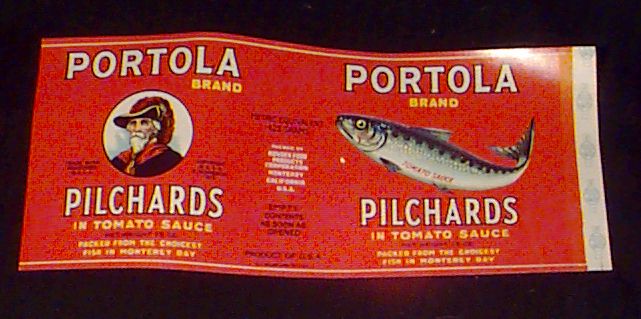
As far as I know, sardine is what the French called it and pilchard is what the British called the same fish. About 50 years ago, pilchard is what they called it here on the West Coast of the the U.S. as well. As a matter of fact, my boss's boss (who once was my boss, once upon a time) visited us and distributed small tokens - her gift to VT and I was an empty can with this antique label on it:
http://www.canneryrow.net/labels/portola_pilch_tomato.jpg
However, there are no more sardine canneries here; there were three in Fish Harbor when I started, and they're all gone now. One, owned by a fishermen's co-op closed because of mismanagement; the second, mainly a tuna cannery that occasionally canned sardines on the side, was bought out by overseas interests and then closed, because canning overseas is cheaper; and the third, while still open, canned fish for pet food - moved their entire canning operation to the Midwest and now are only a labeling facility. A fourth cannery in Wilmington, also for pet food, presumably closed for the same reasons; but I would hope it was also because it was just plain disgusting. A cannery that opened in Monterey shortly after I started also closed a few years ago.
Another smaller can sits next to the big empty one, labeled California Girl® Sardines, with a logo of female surfer on a longboard. I purchased it in a supermarket in San Pedro last summer, and I have no doubt that the fish inside were brought to shore just down the hill (or possibly up the coast in Monterey). However, turn the can over and it says "Product of Thailand." It's cheaper now to pack them in fifty pound boxes, freeze them, ship them overseas, can them there, and ship them back to the U.S. to be sold in the same town they were landed
I remember my first job out college was being a fisheries observer. This was before they prohibited foreign vessels from fishing in the US EEZ (Exclusive Economic Zone - the zone between the coastline and 200 miles offshore) as long as they had proper permitting and a United States observer on board. I spent two months on a Polish freezer/trawler fishing for Pacific hake off Oregon and Washington. Partly they fished on their own and partly they did joint ventures, where they acted as mother factory ship to smaller American boats, who would make a haul and bring the cod-ends (the full, bag end of the trawl net) to the ship to be processed. The whole lower deck was a factory that processed the fish into fillets or headed-and-gutted mostly whole fish, which was then flash frozen and boxed. When they'd filled their hold with processed fish, they would tie up to a cargo ship for about three day to unload everything. I assumed the freighter would then head back to Poland to unload the catch, but the captain told me that, no, the cargo ship would unload either in British Columbia or a Washington port, and most of the fish would wind up back in US markets, to be sold as an import! That floored me at the time.
As far as I know, sardine is what the French called it and pilchard is what the British called the same fish. About 50 years ago, pilchard is what they called it here on the West Coast of the the U.S. as well. As a matter of fact, my boss's boss (who once was my boss, once upon a time) visited us and distributed small tokens - her gift to VT and I was an empty can with this antique label on it:
http://www.canneryrow.net/labels/portola_pilch_tomato.jpg
However, there are no more sardine canneries here; there were three in Fish Harbor when I started, and they're all gone now. One, owned by a fishermen's co-op closed because of mismanagement; the second, mainly a tuna cannery that occasionally canned sardines on the side, was bought out by overseas interests and then closed, because canning overseas is cheaper; and the third, while still open, canned fish for pet food - moved their entire canning operation to the Midwest and now are only a labeling facility. A fourth cannery in Wilmington, also for pet food, presumably closed for the same reasons; but I would hope it was also because it was just plain disgusting. A cannery that opened in Monterey shortly after I started also closed a few years ago.
Another smaller can sits next to the big empty one, labeled California Girl® Sardines, with a logo of female surfer on a longboard. I purchased it in a supermarket in San Pedro last summer, and I have no doubt that the fish inside were brought to shore just down the hill (or possibly up the coast in Monterey). However, turn the can over and it says "Product of Thailand." It's cheaper now to pack them in fifty pound boxes, freeze them, ship them overseas, can them there, and ship them back to the U.S. to be sold in the same town they were landed
I remember my first job out college was being a fisheries observer. This was before they prohibited foreign vessels from fishing in the US EEZ (Exclusive Economic Zone - the zone between the coastline and 200 miles offshore) as long as they had proper permitting and a United States observer on board. I spent two months on a Polish freezer/trawler fishing for Pacific hake off Oregon and Washington. Partly they fished on their own and partly they did joint ventures, where they acted as mother factory ship to smaller American boats, who would make a haul and bring the cod-ends (the full, bag end of the trawl net) to the ship to be processed. The whole lower deck was a factory that processed the fish into fillets or headed-and-gutted mostly whole fish, which was then flash frozen and boxed. When they'd filled their hold with processed fish, they would tie up to a cargo ship for about three day to unload everything. I assumed the freighter would then head back to Poland to unload the catch, but the captain told me that, no, the cargo ship would unload either in British Columbia or a Washington port, and most of the fish would wind up back in US markets, to be sold as an import! That floored me at the time.